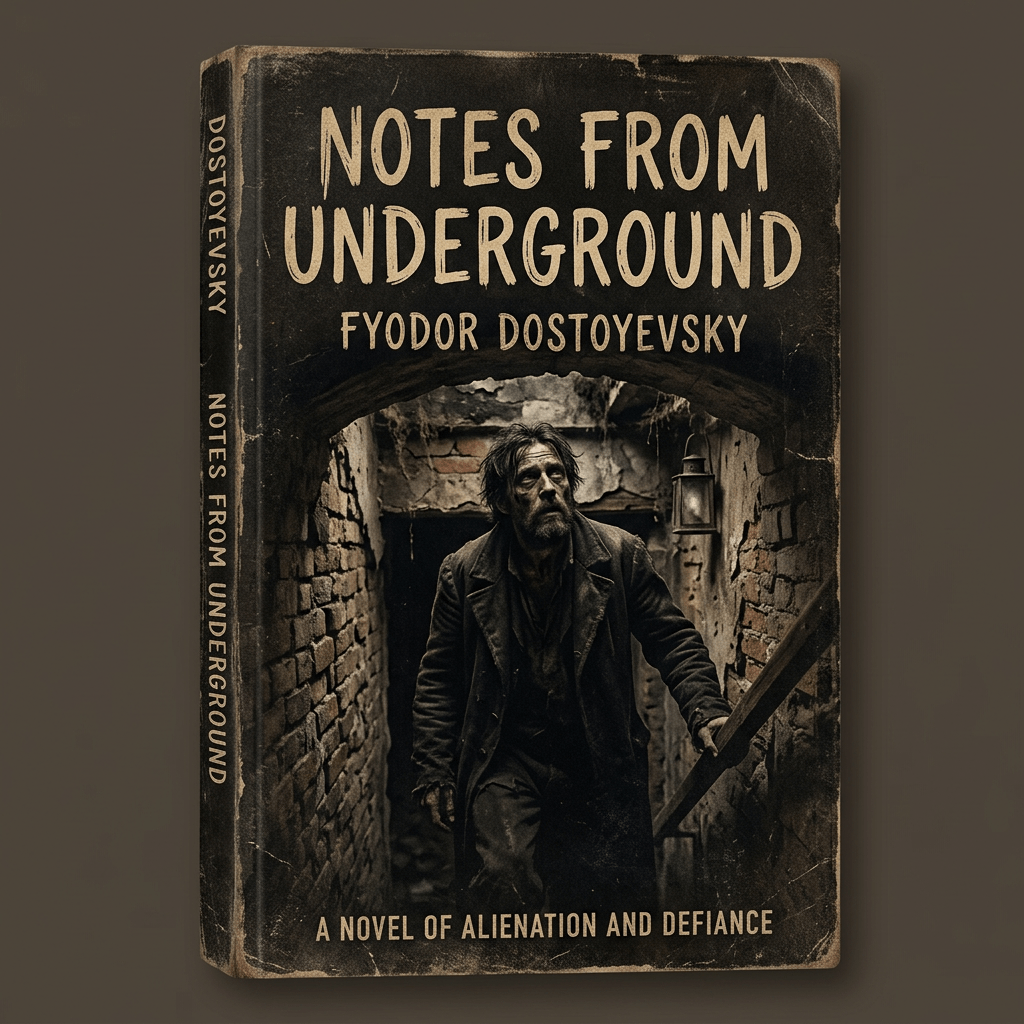
By Fyodor Dostoevsky
1864, Russia
Narrated by the Underground Man, a resentful, isolated, and bitter individual who lives in poverty in St. Petersburg. He is a retired civil servant who, out of resentment toward society, isolates himself from others. Although highly self-conscious, he is an overthinker and constantly at war with himself. The book introduces suffering, free will, alienation in modern society, as well as necessitarianism, and more.
Part 1: Underground
The narrator begins by discussing himself and his views of society. He believes that suffering is an essential part of society and human freedom. Humans experience suffering and spread it within society. When facing injustice, revenge seems to be what restores justice in the world.
The Underground Man, however, is deeply conscious of both his surroundings, and inner state. He too, like others suffered, and is spiteful toward his surroundings and desires revenge, but he has reached a point of boredom and inertia.
Necessitarianism: The concept that there is only one possible way for the world to exist, denying alternative possibilities. The narrator repeatedly refers to “Two plus two equals four” as a way to illustrate this concept. Individuals often conform to societal norms and are easily influenced to act in ways that prove their existence within society.
The Underground man wants to have the freedom to say, “two plus two equals five”. The concept that “two plus two equal four” enrages him, symbolizing a barrier between human being and their free will.
Part 2: Apropos of the Wet Snow
He begins by talking about an officer who insulted him once and whom he passes frequently on the street. Remaining unnoticed, he feels invisible to the officer. The underground man’s frequent thoughts about revenge cause him to borrow money, buy an expensive coat, and intentionally bump into him. However, when this happens, the officer does not notice him at all.
The underground man then talks about a farewell party for an old school friend whom he hated when he was younger. Feeling unnoticed, isolated and uninvited, he joins the group’s conversation in order to attend the party. They agree to meet 5:00PM, but when he arrives, he realizes that they had changed the time to 6:00PM without informing him. Upon their arrival, the Underground Man, feeling insignificant, enraged and resentful, gets into an argument with them and uses them as an example to describe his hatred toward society.
Towards the end of night, he meets a young woman named Liza, a prostitute. The Underground man talks to Liza about her position in society, explaining that after a few years she will be worthless to society, and that when she dies, no one will be there to remember her or visit her grave. During their interactions, he hands her his address. Moved by this harsh prediction of her future, she goes to his house after several days.
The underground man, fearing that she may come, and see his poverty, humiliates her upon her arrival, stating that he only wanted to gain power over her. She eventually leaves; he tries to follow her but cannot find her. The Underground Man faces intense inner conflict, unable to make a clear decision throughout the book.
Final thoughts
Dostoyevsky’s writing in this book, like his other books are very heavy and detailed. The stories can be understood only by careful reading and rereading. The stories, characters, places, and events all depict realities of society and the inner and outer state of individuals.
Rating: 5/5


Leave a Reply